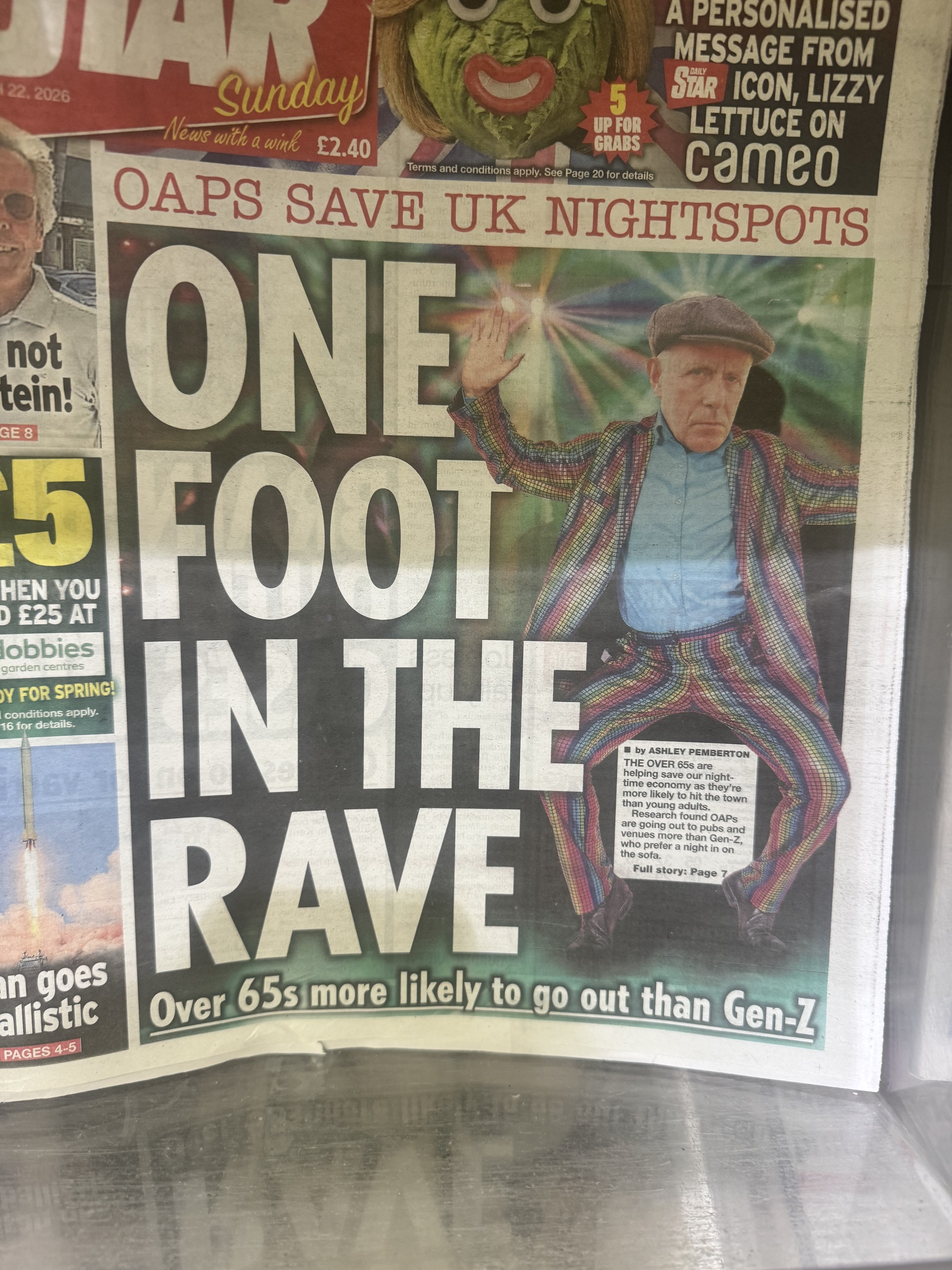
I was reading this thing somewhere where someone said the whole idea of clubs are dead and was thinking that big mainstream thing does seem a little tired but if I look at smaller clubs they are often kind of the equivalent of what the underground northern soul scene was. A dedicated crew of people that just love music and want to let it out to good music. Long story short I don’t buy the clubs are dead argument at all but maybe a UK perspective means we see it through our long history of supporting underground music in the UK fro the 60s onwards… Anyway was just pondering it after seeing someone moaning somewhere…
There’s so many different angles to this. Depends on you ask, where they live, how they old they are, what they’re into… Also depends on whether we’re talking about clubs purely as premises - or the whole clubbing lifestyle we’ve grown up with?
I voted NO because there are still a few diehard venues around Europe that have it, but I think the culture is so far removed from the outlaws of acid house now, that that linear trajectory is probably now lost to anyone under 45 and the venues that do survive could never be the same now.
Elsewhere in the world though, I’ve watched videos in Kenya, South Africa, Indonesia… house music still lives on in locally mutated scenes and that’s where it feels like the energy is now
Yeah not sure I agree with that, but I guess it kind of depends where you are. Here in Leeds there’s certainly an argument for it. 10-15 years ago we had arguably the most vibrant club scene outside of London. Now its completely on its arse. At least 5 key venues have closed in the last two years. There are still one or two things happening, but the appetite for going out to clubs seems to have totally flipped, for a myriad of reasons: lifestyle choices, health & mindfulness, social media, gentrification to name a few. The youth dont wanna be snapped and shamed online while off thier tits. Its all part of it. But then I look across at cities like Manchester, and Newcastle and London obviously there are still some great clubs. That said, if clubs are not dead then I do think they are under the biggest threat they have ever been
No. Not dead yet. Admittedly my view is extremely limited but having seen the multi generational last Lowlife party in full swing I’d say there’s still some life in the scene. Definitely about smaller, underground party vibe as opposed to “clubbing” as a mass movement though.
Not quite but it’s starting to feel more and more like it’s headed that way. I think a lot of it has to do with the price of drinks and the overall cost of a night out in general + the lack of cheap pills in circulation. The youth just can’t afford it anymore at least not week in week out and that has a massive downward spiralling effect on things. When I first started going out I was going out every Friday and Saturday night for less than £30 a night and that was including entry fees and a taxi home now £30 barely gets you entry and two drinks
I work with a few younger lads early 20s who regularly listen to dance music but have never actually been to a single club night before which I find quite bizarre.
There are quite a lot of clubs here in the states and they always feel flat, I think it’s like Joe says, the incessant need to document every waking second is an absolute buzzkill for many. Plus the cost of clubs and the way here in the States it’s been invaded by the bottle service crew has meant that young kids don’t necessarily find out about the places to get your shoes dirty before they’re over it. Space is Miami is a prime example, it can be upwards of $350 to get in and once you’re in it’s a lot of people trying to tell the world they’re at Space. It’s soul destroying.
Not really. I’m still attending and playing at sold-out events in Glasgow. Things have definitely shifted though, it’s gone a bit more underground and DIY again. A lot of people are putting on smaller, community-style events instead of relying on big-name guests to sell tickets. Nights in pub function rooms and other unusual spaces are becoming way more common.
Could something on the scale of Fabric operate weekly outside of London? Absolutely not. But in my opinion, that’s not necessarily a bad thing. House music isn’t really the default music that “normies” expect to hear on a night out anymore — but honestly, that all got a bit much and brought plenty of bellends into the mix.
In Australia clubs seem to be on the out, while events at event spaces, warehouses, makeshift spaces (parking lots/art galleries/halls/sporting facilities/etc)seem to be where underground music is going.
My boys both go out to loads of club nights and gigs. My eldest is in the process of trying to put a night on together with a couple of mates. My youngest is more into bands and now has a big chunk of my record collection with Talking Heads being his favourite - seeing David Byrne with his recently was so special that we are now trying to get tickets for any of the Edinburgh show too.
The thing that saddens me for their generation is the fear a lot of them have of being out of control at any point with social media/camera phones/ etc. House parties are more my jam these days.
I get the impression that if you’re in your 20s and into big room and EDM type stuff then you’re only experiencing that at festivals or some massive place like Drumsheds or WHP
Thats probably the most mainstream dance music gets at the moment and there’s no small venues to accommodate it (to my admittedly limited knowledge) whereas back in the day even when UK Garage was the flavour of the month with the normies, it was still about going to club nights with a few hundred people.
The 2020s equivalent might be into hip hop, rnb etc and its all slow and moody as fuck for the most part. Not nearly as much danceable energy to it, it certainly doesnt necessitate a whole club scene to be built around it.
So although we can moan about the casual listeners and bellends in the 90s/early 00s, them making up the numbers at least meant clubs stayed open.
I think there’s a broader economic crisis around cost of living and independent venues on top of all the other stuff. But, at the end of the day, people are always going to want to come together and dance. They might be in the doldrums somewhat rn but clubs won’t die.
when the UK superclubs had a disappointing milennium there were all these angsty articles about how ‘clubbing was dead’, how the kids were now into nu-metal or timbaland instead, how Ibiza was on its knees, how house was the sole preserve of people´s Dads. Losing their nerve, the likes of fatboy slim, basement jaxx, oakenfold started branching away from dance on their CDs in a desperate bid to remain relevant. Muzik started talking up Audio Bullys as the saviours of dance music. It all got a bit silly.
That said, it is true that the early 2000s were a necessary correction to 90s DJ excess (although not too convinced Ibiza ever got the memo…) It was exciting to live through it and see what emerged from the fallout. Which is why Shoreditch with its abundance of old industrial units was fertile ground to try something different. Which is why I’m not as gloomy as most.
Because it feels like history is repeating itself yet again. Given how many students, art kids, freelancers move to London, there will always be demand for community and a leftfield, I’m sure people party in different, cheaper ways now, but I guess the real question is whether grassroots music will ever again be rooted in familiar, famous venues, or whether music people will have to continually come up with new ideas and locations to keep things alive?
Here in Spain, it certainly feels like a cluster of music bars in the Poble Sec area are the last stand for independent dance culture. The scene has inevitably aged and it all means nothing to kids weaned on reggaeton or latin pop, but then again who ever imagined Rosalia going full classical-techno at the Brits?!
I think looking forward, much will depend on the wider economics and what happens to empty real estate in the years ahead. With governments taxing landlords and cracking down on non-doms will that free up more space for new scenes to flourish…?
Mrs J_C works with a fair few young people, they barely drink, don’t go out much, they prefer getting together in someone’s place and watching films and playing role playing board games. If they do go out they almost do it ironically
Not true about the “lack of cheap pills in circulation “. I think illegal drugs are one of the very few inflation busting items over the last few years in the U.K. So people would be able to afford them, just not the rest of the night out. And club owners make their money from the drinks. The overall cost of a traditional night out (entrance, drinks, kebab, taxi) has definitely played a part in less people going to mainstream clubs regularly.
I think the other thing is that there aren’t as many teens/20s into music as there used to be. If you see someone with headphones listening to something there’s a good chance its a podcast or YouTube etc.
In the 70s and 80s it was quite normal for kids of 8-9 years old to get into pop music and start buying records and tapes. I get the impression that during the 90s/early 00 that became less common (replaced by computer games maybe?) and the starting point was more early teens.
Then the next gen after that don’t need to spend money on music because of the internet so it becomes less of a passion, so less people are into the idea of a night out at a club. Theyre going out to eat, see comedy shows etc.
Think I mentioned this before, but why go out to get hassled by security, dance in a stale smelling club, buy over priced drinks, music you can hear at home/online AND not be reliant on the only place you can meet a member of the opposite sex because you have tinder, grindr etc?
I mean I love clubs but see them through rose tinted specs I think.
Of course, we love it, but all my daughter’s friends (mid twenties) might do one festival a year and that is pretty much it. Anywhere I go these days, take out the oldies and the place would be half empty. Mid 80’s you’d almost never see anyone over 30.